Wildvia
Nature Clock app icon Nature Clock: Living Worlds

A living world
on your desktop.

Real wild places that follow your own time of day and season, visited by wild animals that keep their own hours.

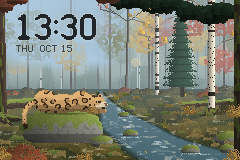
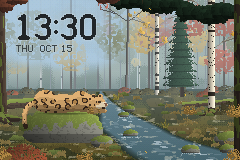
Nature Clock at Changbai Creek: an autumn forest stream with golden birches and a red maple in the mist, an Amur leopard resting on a mossy boulder, and the time, 13:30, in the top left.
Shown at four times its real pixel size. Every picture on this page is a moment the app actually drew.

macOS 12 Monterey or later · Apple silicon and Intel · English and 简体中文

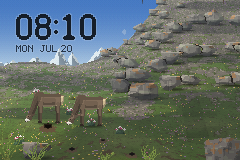
A small scene from a wild place, and a clock. The light follows your local time, and the moon shows its real phase. The seasons turn with your calendar. And now and then, something walks in.

An animal comes out of the trees, goes about its business for a while, and leaves. You didn't ask it to come, and you can't make it stay. That's what makes it feel alive.

One day at Changbai Creek

From before dawn
to after dark.

Eight moments from a single October day, exactly as the app drew them.

Changbai Creek at 13:30: an Amur leopard rests on its mossy boulder by the stream.

13:30  Early afternoon. The Amur leopard has come to rest on its boulder by the water. It may stay ten minutes or an hour.

Visits are different every day. On another day, other animals come at other times.

The same place, all year.

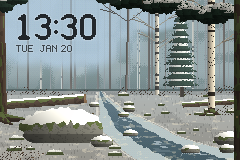
Each place keeps its own calendar. At Changbai Creek the stream ices at its edges in January and the forest goes gold and red in October. In Xishuangbanna the year runs instead through morning fog, a hot dry season and the rains.

Changbai Creek in January: snow on the banks and boulder, ice at the edge of the stream.
WinterSnow and ice
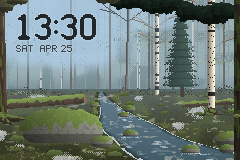
Changbai Creek in late April: bare trees in mist with the first fresh green.
SpringThe first green
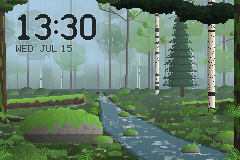
Changbai Creek in July: full green leaves and lush banks.
SummerFull leaf
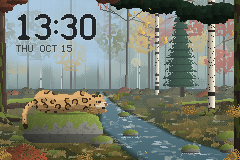
Changbai Creek in October: golden birches and red maples, with a leopard on the boulder.
AutumnGold and red
The places

Five places.
Each one real.

Each is a real landscape, seen as if by a wildlife camera set low to the ground. Switch between them from the little wooden sign in the clock's corner, or pick one from its map.

Changbai Creek: an autumn forest stream with an Amur leopard on a mossy boulder.

Changbai Creek长白山

Jilin, China · a forest stream below Changbai Mountain

Spruce, birch and maple along a clear stream. An Amur leopard comes to rest on a mossy boulder at the water's edge, otters fish, deer step out between the trunks, and once or twice a week there's a brief glimpse of an Amur tiger.

Species
10
Availability
Included

We've only named a few of each place's animals here. You'll meet the rest in the clock, and find every one of them in the Nature Guide.

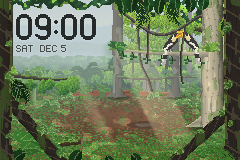
A rainforest salt lick in Xishuangbanna on a December morning: shafts of sunlight slant through fog onto red earth, and two great hornbills perch on a mossy bough.
Xishuangbanna on a December morning: two great hornbills on the bough as the fog burns off.
The animals

They come when they will.

Every animal keeps its own hours, its own seasons and its own way of arriving and leaving.

Woodpeckers come by day; the sable mostly by night. Chipmunks and marmots disappear for the winter. A snow leopard pads along the crags about twice a month. An Amur tiger passes through the far trees once or twice a week, for a minute or so.

Every moment is worked out from the date and time alone, so nothing is staged for you and nothing is lost when your Mac sleeps.

5wild places, from a Changbai forest stream to the Serengeti
51species, each with its own hours, habits and seasons
⅔of the time, the forest at Changbai Creek is simply empty, as a real one would be
The Nature Guide

A field guide,
inside the clock.

When something walks in, you'll want to know who it is. Press G, or open the book in the clock's settings, and a small illustrated field guide lies open in the window.

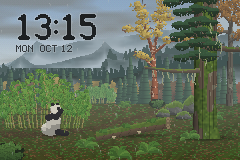
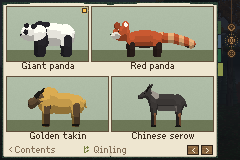
The Nature Guide open at the Qinling chapter: colour plates of a giant panda, a red panda, a golden takin and a Chinese serow, each named beneath. A small lantern glows in the corner of the giant panda's plate.
The Qinling chapter, opened while a giant panda was in the clock.

It knows who's here now.

A small lantern glows on the plate of whichever animal is in your clock at this moment, marked Here now.

It's drawn as a little cloth-bound book, with paper pages and a thumb tab for each place. Every place is a chapter of colour plates, one for each animal that visits, with its full name beneath. Open a plate and the animal has a page of its own, with its name in English and Chinese and one short line about it.

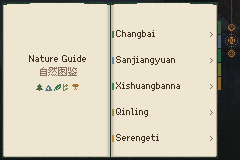
The Nature Guide's contents: Changbai, Sanjiangyuan, Xishuangbanna, Qinling and Serengeti, each with a coloured thumb tab.
ContentsA chapter for each place
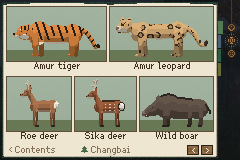
The Changbai chapter: plates of an Amur tiger, an Amur leopard, a roe deer, a sika deer and a wild boar.
ChangbaiEvery animal, named
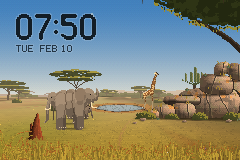
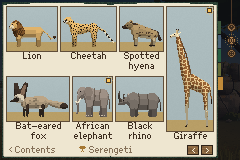
The Serengeti chapter: plates of a lion, a cheetah, a spotted hyena, a giraffe standing through two rows, a bat-eared fox, an African elephant and a black rhino.
SerengetiFourteen animals, once it's yours
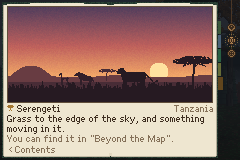
The Serengeti's frontispiece before it is bought: the plain at dusk with dark shapes in the grass, and the words: Grass to the edge of the sky, and something moving in it. You can find it in Beyond the Map.
Before you buyThe land at dusk, and shapes in the grass
  • Drawn from the scene itself.

    The plates use the same pixel art as the animals in the clock, seen in plain daylight and at a shared size, so they read as one book. Now and then an animal on its page shifts into a second pose.

  • Turn the pages.

    Leaf through with the arrows or ← →, step back with Esc, and jump between places with the thumb tabs. In English or Chinese, the book is laid out exactly alike.

  • Nothing to complete.

    The guide doesn't count, rank or record anything: no checklists, no rarities, no progress. It's a book to look things up in. The animals are still yours to discover in the clock.

  • It never sells.

    A place you haven't bought keeps its animals to itself. Its chapter shows only the land at dusk, a few shapes in the grass, and where to find it on the map.

Made to stay
out of the way.

A native Mac app, built to live beside your work for hours at a time, quietly.

On every desktop, or just one.

By default it floats above your windows on every Space, even beside full-screen apps, without pulling you out of them. Or make it an ordinary window that others can cover.

⌃⌥N

Put away into a pine.

A small pixel pine lives in your menu bar. Click it to tuck the clock away and again to bring it back, or press ⌃⌥N from any app.

Anywhere, any size.

It starts in the top-right corner, clear of browser toolbars. Drag it anywhere and it remembers. Resize it freely; the pixels stay crisp.

Light on your Mac.

It redraws only what moves. Hidden, covered or on another Space, it stops drawing entirely, and catches up the moment you look again.

EN · 中文

English and Chinese.

The clock, its map, the guide and the menus switch between English and Simplified Chinese at once. It starts in your Mac's language.

Data not collected.

No analytics, no advertising, no tracking, no account. The sun, the moon, the seasons and every animal's visits are worked out on your Mac, with no internet connection needed. Its few settings stay on your Mac, and purchases are handled entirely by Apple.

Tech Specs

Availability

Coming soon to the Mac App Store

Places

Five: Changbai Creek, Sanjiangyuan, Xishuangbanna and Qinling are included.

The Serengeti is a paid in-app purchase.

System

macOS 12 Monterey or later

Apple silicon and Intel

Languages

English, Simplified Chinese

Internet

Not required

Data collection

None

From Wildvia

A gateway into
the natural world.

Wildvia makes calm, carefully made things about real wild places and the animals that live in them. “Via” is Latin for a way, or a road: Wildvia is a way into the wild, an opening you can step through for a moment, wherever you happen to be.

Nature Clock is the first. Next is Nature Observer, for going outside: observing nature and identifying the species you meet. It's in development.